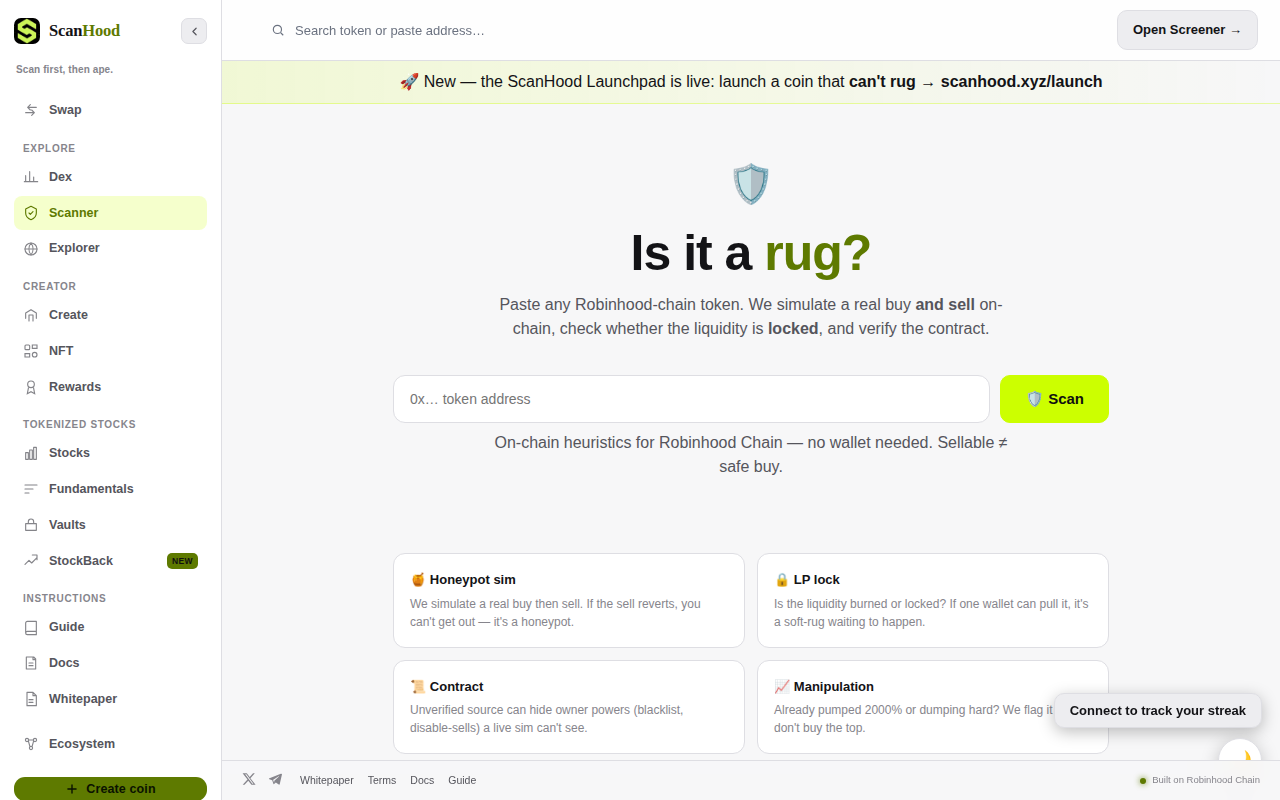
ScanHood’s live scanner flagged the majority of Robinhood‑chain tokens with caution or danger on November 13.
SCANHOOD FLAGS 8.3% OF 760 ROBINHOOD-CHAIN TOKENS AS RUG RISKS ON NOV 13
*Daily ScanHood data shows a majority of tokens on the Robinhood chain carry caution or danger flags. Investors face a thin margin of safety amid rampant honeypot and liquidity‑lock threats.*
ScanHood released its daily safety scan for Robinhood‑chain tokens on November 13. Seven hundred sixty tokens were examined by a live on‑chain simulation that tests both buy‑sell execution and liquidity security. Only one hundred ninety‑three tokens cleared the test without flags. Five hundred four were marked caution, and sixty‑three earned a danger label. The scanner’s verdict is stark: the majority of tokens on this emerging chain carry hidden risks that can trap investors or enable sudden liquidity pulls. With the Robinhood ecosystem attracting new DeFi projects, the data serves as a warning bell for anyone considering a purchase today.
What does the ScanHood daily tally reveal?
On November 13, ScanHood scanned seven hundred sixty Robinhood‑chain tokens. One hundred ninety‑three passed the safety simulation, five hundred four received a caution flag, and sixty‑three were marked danger. The scanner simulates a real on‑chain buy then sell; a reverted sell classifies the token as a honeypot. It also checks whether liquidity is locked or burned, flagging any wallet that could pull funds as a soft‑rug risk. The data shows that only a small slice of tokens cleared both tests, underscoring a high exposure to contract‑level exploits on the chain.
Why does a caution flag matter more than a pass?
A caution flag indicates that the token failed one of the heuristic checks—most often liquidity‑lock or contract verification. Unverified contracts can hide owner powers such as blacklisting or disabling sells, which a live simulation cannot expose. Investors may still be able to sell, but the underlying risk remains. The scanner’s design treats sellability as distinct from safety, warning that a token that can be sold today may become unsellable tomorrow if the owner activates hidden functions.
How does the 2000% pump warning factor into risk assessment?
The ScanHood interface flags tokens that have already seen massive price spikes, citing a two‑thousand percent surge as a red flag for manipulation. Such rapid inflation often precedes a hard dump, turning early buyers into victims. By highlighting these outliers, the scanner helps users avoid buying at a peak that is likely to collapse, reinforcing the platform’s focus on protecting against both honeypot traps and market‑timing scams.
Can developers launch a rug‑proof token on Robinhood Chain?
ScanHood recently launched a dedicated launchpad that promises to create coins that cannot rug. The service runs the same buy‑sell simulation and liquidity‑lock verification before allowing a token to go live. While the launchpad adds a layer of pre‑screening, it does not eliminate all risk; contracts can still be updated after launch, and external market forces can affect token stability. The tool is a step forward, but investors must remain vigilant.
Frequently asked questions
How many Robinhood-chain tokens failed ScanHood's rug check on November 13?
Eight point three percent of the seven hundred sixty tokens scanned were flagged as failed.
What does a danger flag indicate in ScanHood's report?
A danger flag marks tokens where the simulated sell reverted or liquidity can be pulled, signaling a high risk of being a honeypot or soft rug.
Does ScanHood's launchpad guarantee a rug‑proof token?
The launchpad runs the same safety simulation before launch, but contracts can still be altered after deployment, so it does not guarantee absolute protection.
The ScanHood snapshot paints a grim picture for Robinhood‑chain newcomers. With less than a quarter of tokens passing unscathed, the odds favor caution over optimism. The launchpad offers a glimmer of hope, yet the underlying contract mechanics remain mutable. Investors must treat every token as a potential trap until proven otherwise, and rely on continuous on‑chain monitoring rather than a single pass. The next wave of DeFi projects will be judged not by hype but by the hard data that ScanHood delivers.
Sources: ScanHood live scan data (https://scanhood.xyz/scanner/)