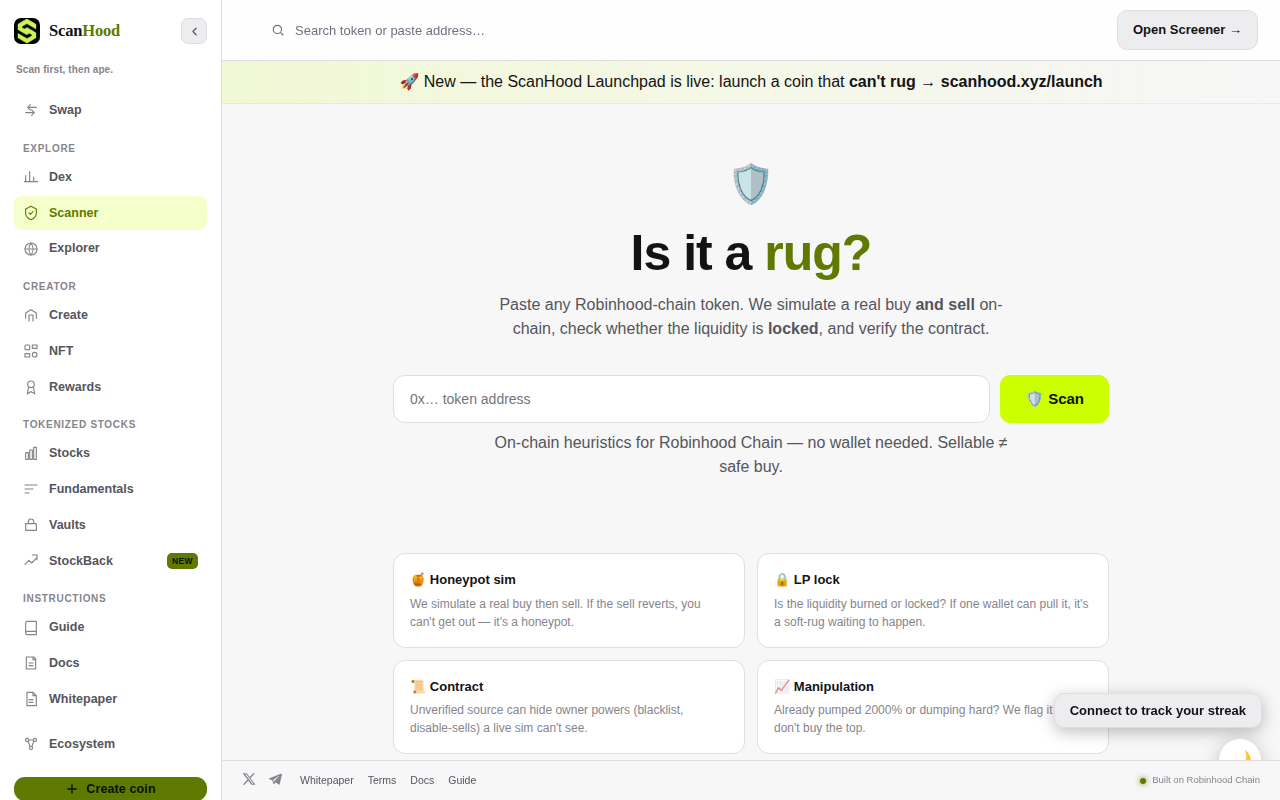
ScanHood’s live scanner categorizes Robinhood-chain tokens into pass, caution and danger on 2026-11-18.
SCANHOOD FLAGS 415 ROBINHOOD-CHAIN TOKENS AS CAUTION, 20 AS DANGER
*Daily ScanHood data shows a flood of risky tokens on Robinhood Chain. *The scanner separates pass, caution and danger, exposing a thin line between sellable and unsafe.*
On 2026-11-18 ScanHood released its daily safety‑scan tally for Robinhood‑chain tokens, exposing a market awash with cautionary signals. Out of five hundred fifty‑seven tokens examined, only a little over a hundred passed every safety gate. Four hundred fifteen tokens raised caution flags, and twenty landed in the DANGER zone, where liquidity and contract flaws could enable a rug pull. The scanner’s real‑time buy‑and‑sell simulation, liquidity lock check, and contract verification provide a hard look at token integrity that many investors overlook. In a space where price spikes can mask underlying traps, ScanHood’s data forces a reality check on every prospective purchase.
How many Robinhood-chain tokens did ScanHood scan on 2026-11-18?
ScanHood processed a total of 557 Robinhood-chain tokens on the date in question. The live scanner split the batch into three safety tiers. One hundred twenty‑two tokens cleared every check and earned a pass label. Four hundred fifteen tokens triggered a caution flag, indicating potential red flags without an outright danger designation. Twenty tokens landed in the DANGER category, meaning the scanner detected conditions that could enable a rug pull or honeypot scenario. The breakdown illustrates a market saturated with contracts that merit scrutiny before any purchase.
What proportion of tokens failed the Rug Check?
Three point six percent of the scanned tokens failed the Rug Check, according to ScanHood’s metrics. A failed Rug Check signals that the simulated sell transaction reverted, a classic honeypot behavior that traps buyers. This failure rate, while numerically modest, translates into dozens of tokens that cannot be safely exited once purchased. The figure underscores the importance of a simulated buy‑and‑sell test, a step many investors skip in favor of price hype.
Which tokens triggered the highest safety alerts?
The twenty tokens flagged as DANGER represent the highest safety alerts in the ScanHood report. These tokens exhibited one or more of the scanner’s critical warnings: liquidity that is not locked or burned, contract code that remains unverified, or owner powers that could blacklist users. When liquidity is controlled by a single wallet, the token is vulnerable to a soft‑rug where the owner can withdraw funds at will. The DANGER label warns investors that the token’s architecture permits a rapid and total loss of capital.
What does ScanHood’s launchpad promise for new tokens?
ScanHood recently launched a dedicated launchpad that claims to let creators issue coins that cannot rug. The platform advertises a pre‑launch safety scan that checks for honeypot behavior, liquidity lock status, and contract verification before a token goes live. By embedding the same on‑chain heuristics used in the daily scanner, the launchpad aims to eliminate soft‑rugs at the source. The promise is a market where every new token arrives with a built‑in safety certificate, reducing the need for post‑launch forensic analysis.
Frequently asked questions
How many Robinhood-chain tokens did ScanHood scan on 2026-11-18?
ScanHood scanned five hundred fifty‑seven Robinhood-chain tokens on that date.
What percentage of tokens failed the Rug Check?
Three point six percent of the scanned tokens failed the Rug Check.
How many tokens were flagged as DANGER?
Twenty tokens were flagged as DANGER in the ScanHood report.
The ScanHood report paints a stark picture: a majority of Robinhood‑chain tokens carry cautionary warnings, and a small but critical subset are outright dangerous. Investors who rely solely on price momentum risk stepping into contracts that can lock or drain their funds. With the launchpad promising pre‑emptive safety checks, the onus shifts to token creators to meet higher standards. Until the market internalizes these safeguards, the scanner’s daily alerts remain a vital lifeline for anyone looking to navigate the DeFi frontier without getting burned.
Sources: ScanHood live scan data (https://scanhood.xyz/scanner/)