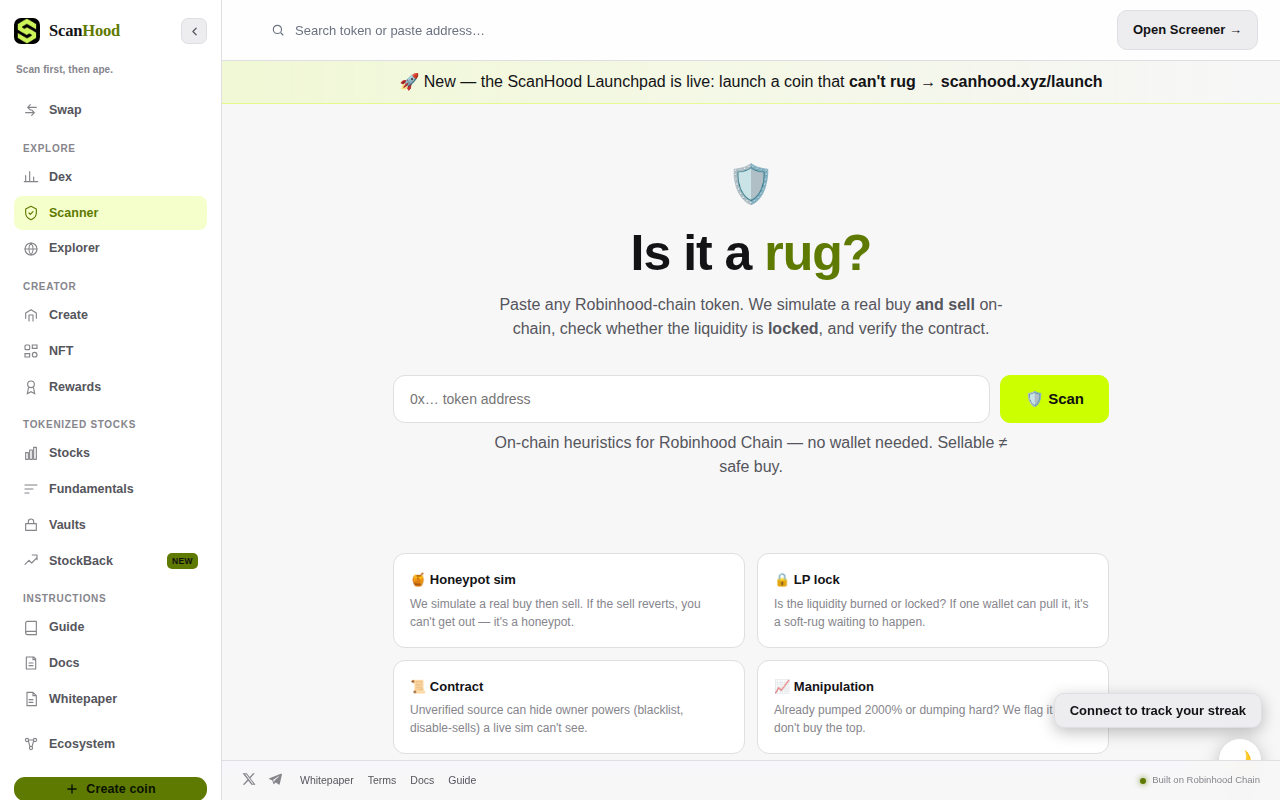
ScanHood’s live scanner flagged 82 tokens as DANGER and 717 as caution among 1,117 Robinhood‑Chain tokens on Nov 14 2026.
SCANHOOD FLAGS 7.3% OF 1,117 ROBINHOOD-CHAIN TOKENS AS RUG RISKS
*On 2026-11-14 ScanHood’s live scanner evaluated every Robinhood‑Chain token. Seven‑point‑three percent failed the rug check, exposing a hidden danger pool. The data forces investors to question safety beyond surface liquidity.*
On November 14, 2026 ScanHood’s live scanner completed a full sweep of the Robinhood‑Chain ecosystem, examining every token listed on the network. The scan covered 1,117 tokens and produced a stark safety profile: 318 passed, 717 were flagged for caution, and 82 triggered a DANGER alert. The 7.3% failure rate is a wake‑up call for investors who often equate liquidity with safety. ScanHood’s methodology simulates real‑world buys and sells, checks liquidity locks, and inspects contract verification, delivering a granular risk picture that goes beyond surface metrics. The results expose a hidden layer of vulnerability that could catch even seasoned traders off guard.
How many Robinhood-Chain tokens failed ScanHood’s rug check on Nov 14, 2026?
ScanHood processed 1,117 tokens on the Robinhood Chain on 2026-11-14. The Rug Check flagged 7.3% of those tokens as failures. That translates to roughly 82 tokens marked as DANGER, where the liquidity can be pulled or contract powers enable a rug. The remaining tokens fell into caution or pass categories, but the failure rate alone signals a non‑trivial risk surface for any investor seeking a clean entry.
What does ScanHood’s safety‑scan tally reveal?
The daily tally shows 318 tokens passed the safety scan, meaning they cleared both honeypot simulation and liquidity‑lock verification. 717 tokens received a caution flag, indicating potential red flags such as unverified contracts or soft‑rug conditions. 82 tokens earned a DANGER label, the highest risk tier, where liquidity is either un‑locked or contract owners retain powers to drain funds. The distribution underscores that the majority of Robinhood‑Chain tokens carry at least a cautionary signal.
Why do caution and danger flags matter for investors?
A caution flag warns that a token may have hidden owner powers, unverified source code, or liquidity that is not fully secured. While not an outright block, it signals that a sell could be hindered or that the token could be manipulated. A DANGER flag, however, marks tokens where the sell simulation reverted or liquidity can be withdrawn at will, effectively a honeypot or soft‑rug. Investors ignoring these signals risk being unable to exit positions, turning a perceived gain into a total loss.
Can the new ScanHood Launchpad prevent future rug pulls?
ScanHood recently launched a launchpad that promises to “launch a coin that can’t rug.” The platform integrates its on‑chain heuristics—buy‑sell simulation, LP‑lock verification, and contract audit—into the token creation flow. By requiring a clean scan before a launch, the service aims to eliminate the most common rug‑pull vectors. While the launchpad cannot guarantee market forces won’t create new exploits, it raises the baseline safety for any token minted on Robinhood Chain through ScanHood.
Frequently asked questions
How many tokens passed ScanHood’s safety scan on Nov 14 2026?
318 tokens passed the safety scan, clearing both honeypot simulation and liquidity‑lock verification.
What percentage of the scanned tokens failed the rug check?
7.3% of the 1,117 scanned tokens failed the rug check.
What does a DANGER flag indicate in ScanHood’s report?
A DANGER flag marks tokens where the sell simulation reverts or liquidity can be pulled, indicating a high‑risk rug‑pull scenario.
The ScanHood data paints a clear picture: a sizable slice of Robinhood‑Chain tokens carry hidden risks that standard market data overlooks. With 7.3% flagged as outright rug threats and the majority under caution, investors must demand more than liquidity snapshots. The new launchpad offers a proactive shield, but only disciplined users who heed the scanner’s warnings will avoid the next wave of rug pulls. The on‑chain reality is unforgiving; the tools are now available, the choice is theirs.
Sources: ScanHood live scan data (https://scanhood.xyz/scanner/)