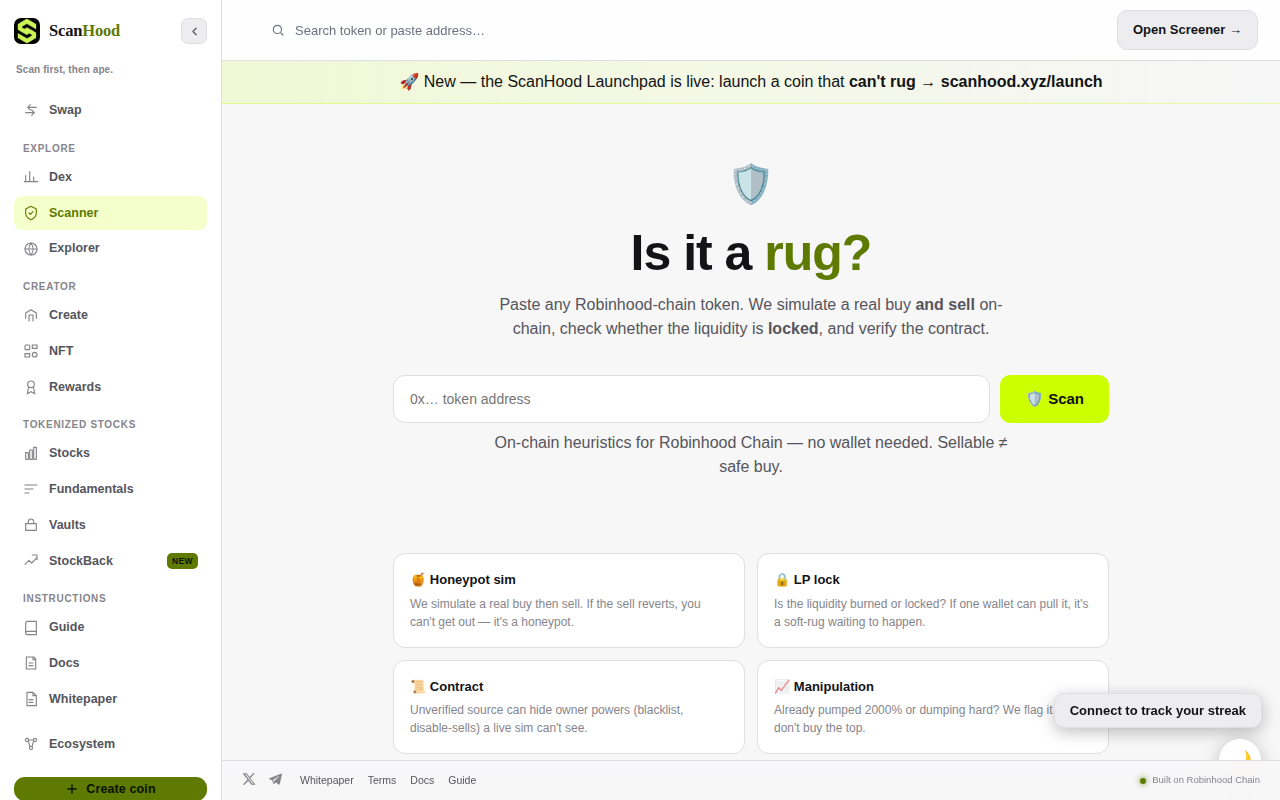
ScanHood's dashboard on November 19, 2026, displays 126 passes, 530 cautions, and 48 DANGER flags for Robinhood‑Chain tokens.
SCANHOOD FLAGS 48 ROBINHOOD-CHAIN TOKENS AS DANGER ON DAILY SCAN
*On November 19, 2026 ScanHood scanned 704 Robinhood‑Chain tokens. Only 126 passed, while 48 were marked DANGER. The data underscores a volatile landscape where sellability is no guarantee of safety.*
The Robinhood Chain saw a flood of new tokens on November 19, 2026, but not all were safe. ScanHood's live scanner, a real‑time on‑chain heuristic tool, evaluated 704 tokens in a single day. Only 126 cleared every test, while 530 raised caution alerts and 48 were labeled DANGER. The DANGER flag indicates a failed sell simulation, meaning investors cannot exit their position without a revert. This snapshot reveals a market where the majority of tokens carry at least a warning, and a non‑trivial slice are outright traps.
Investors often equate sellability with safety, but ScanHood proves the two diverge sharply on the Robinhood Chain. The platform’s three‑pronged analysis—buy‑sell simulation, liquidity lock check, and contract verification—exposes hidden vulnerabilities. With 6.8% of tokens failing outright, the data urges a rethink of how DeFi participants assess risk in a rapidly expanding token ecosystem.
How many Robinhood-Chain tokens failed ScanHood's rug check on Nov 19?
ScanHood's live scanner processed 704 tokens on 2026-11-19. Forty‑eight tokens received a DANGER flag, representing the 6.8% that failed the rug check. The remaining tokens split between 126 passes and 530 caution alerts. A DANGER flag means the simulated sell reverted, indicating a honeypot or a soft‑rug scenario where liquidity can be pulled by a single wallet. The failure rate, while numerically small, translates into a significant risk pool for investors chasing high‑yield DeFi projects on the Robinhood Chain.
What does ScanHood's scanner actually test?
The platform runs three core heuristics without requiring a wallet. First, it simulates a real on‑chain buy then attempts a sell; a reverted sell marks the token as a honeypot. Second, it checks whether liquidity is burned or locked; a single‑wallet control flags a potential soft‑rug. Third, it verifies contract source code; unverified contracts can hide owner powers like blacklisting or disabling sales. Additionally, ScanHood flags tokens that have already pumped 2000% or show dumping patterns, warning users against buying at a peak.
Why does a caution flag matter for investors?
A caution flag signals that the token passed the basic sell test but still exhibits red flags. These may include unlocked liquidity, unverified contracts, or suspicious price manipulation. While not outright dangerous, such tokens carry elevated risk that can turn into a rug pull if conditions change. Investors relying solely on the ability to sell may overlook these subtleties, exposing themselves to sudden loss of capital. ScanHood’s layered approach forces a deeper due‑diligence step before committing funds.
What new tool does ScanHood offer to prevent rug pulls?
ScanHood recently launched a dedicated Launchpad at scanhood.xyz/launch. The service promises to let creators deploy coins that cannot rug by integrating the same on‑chain heuristics at launch. By requiring liquidity lock verification and contract transparency from day one, the Launchpad aims to reduce the pool of DANGER‑flagged tokens. Early adopters can benefit from a pre‑screened environment, though the platform still advises users to monitor post‑launch activity.
Frequently asked questions
What percentage of Robinhood-Chain tokens failed the rug check on November 19, 2026?
6.8% of the 704 tokens scanned failed the rug check, resulting in 48 DANGER flags.
How many tokens passed ScanHood's safety scan on that day?
126 tokens passed the ScanHood safety scan on November 19, 2026.
What does ScanHood's rug scanner evaluate?
It simulates a real buy and sell, checks if liquidity is locked or burned, verifies contract source, and flags manipulation such as extreme price pumps.
The numbers speak plainly: a sizable portion of Robinhood‑Chain tokens are either questionable or outright hazardous. As DeFi continues to attract capital, tools like ScanHood become essential gatekeepers, separating genuine projects from engineered traps. Investors who ignore caution and DANGER flags risk losing funds to honeypots and soft‑rugs. The onus now lies on both developers to meet higher safety standards and on traders to demand rigorous, on‑chain verification before committing capital.
Sources: ScanHood live scan data (https://scanhood.xyz/scanner/)